Exodus 15
Ministries > Thru the Bible with Dr. J. Vernon McGee
https://www.oneplace.com/ministries/thru-the-bible-with-j-vernon-mcgee/
Facebook Twitter Instagram YouTubeWe last saw the children of Israel crossing the Red Sea. In Exodus 15, the Song of Moses recounts their trials, their story of redemption, and their thankfulness to God for deliverance. Soon, their joyful songs of praise faded into tired, bitter complaints as they found themselves weary with thirst. Discover how the cross of Christ can turn even life’s bitter “Marah moments” sweet.
References
Host (Male): Welcome to Through the Bible. As we arrive at Exodus chapter 15, we're celebrating something that only God could have done. When we left the Israelites last time, they were in a crazy dangerous spot, cornered between the Red Sea and the army of Egypt. Everyone knew they were doomed. But then God stepped in. With a sweep of his mighty hand, the waters of the Red Sea split in two, opening up not just land, but dry land for them to pass through to the other side. And when the armies of Egypt were in the same spot where the Israelites had been minutes before, the hand of God closed the sea. Picture yourself standing with them, watching this happen. They're shocked at first and then, maybe they start to dance. And then someone picks up a tambourine and someone else begins to sing, and, well, pretty soon a party breaks out. It must have been a great scene, worthy of all the songs and music and gusto that they could muster. Well, we all know that life has those beautiful light moments, and we also know that life comes with those heavy moments too. And we'll see both in this study with Dr. J. Vernon McGee. Now, let's pray as we open God's word together. Father, we know that in some seasons of our lives we must drink from the bitter waters. When those times do come, Lord, please, through your grace, make them sweet. Teach us what it means to trust you in every season. In Jesus' name. Amen.
Host (Male): We're off to Exodus 15 on Through the Bible with Dr. J. Vernon McGee.
Dr. J. Vernon McGee: Now today, we come to the 15th chapter of the book of Exodus. And the children of Israel have now crossed the Red Sea. And after crossing over, they now join with Moses singing the song of Moses. Before, they were singing the blues, the desert blues. And they'll be returning to the desert blues. That was their theme song when they went through the desert. But right now, having crossed over and been redeemed, why, they very lustily sing out the song of Moses. I'll merely lift out several things in this song because we want to continue to move along. This song is to be compared, I think, with the song of Deborah and Barak that we'll be coming to in the book of Judges. Then you'll recall that David sang many songs. You will find that his Psalms are great, great songs. And you'll find that even Jeremiah, his was a wail and a woe many times, but he had a song. And you'll find that other prophets had songs as we move along through the Old Testament. The New Testament opens with some songs. Doctor Luke records them. There was the song actually of Elizabeth when word was brought that she was to have a child. There was the song of Mary, the marvelous, wonderful song that she sang. There were other great songs connected with the birth of Christ, and finally there was the heavenly host with their tremendous hymn of praise. And then the book of Revelation, when we get a glimpse into heaven, why, we see a great company gathered around the throne of God, and they're singing a new song. And that'll be probably the first time I'm going to ever sing. Up to the present, I've never been able to hit a note, but by that time, with a new body and a new voice, I'm sure I'll be able to sing and join in on the new song. But here is a song, and it's a great song, by the way. And let me read it. "Then sang Moses and the children of Israel this song unto the Lord, and spoke, saying, I will sing unto the Lord, for he hath triumphed gloriously. The horse and the rider hath he thrown into the sea." Now, notice this song. It's a wonderful one, by the way. "The Lord is my strength and my song, and he's become my salvation. He is my God, and I will prepare him an habitation. My father's God, and I will exalt him. The Lord is, our Jehovah is a man of war. The Lord is his name." All of this talk about peace today, it might be well to read this song again. And the one who is Jehovah is a man of war. Then turn to the 19th chapter of Revelation, you see him coming to this earth, and he's going to come to put down all unrighteousness. And friends, until that time, this earth will never have peace, and it can be truly said that God is, and the Lord Jesus, that he is a man of war. Our Lord said he didn't come to bring peace, but a sword. That's what he did the first time. The second time, he's coming to bring peace with the sword because that's the only way you're going to get rid of unrighteousness on this earth. Now, this is a song like so many of them. It recounts the wonderful experience they've had in crossing the Red Sea and what they've seen God do. I think, and I know very little about music, but I think these folk songs today do that same sort of thing, and I don't mean they're praise to God, but they do recount an episode that takes place. That makes a song meaningful. And I'm not sure but what that is the reason that songs have affected the young people so much today, that is, this current type of music, which to me is atrocious, but after all, I'm just a square. But the songs do tell a story. Now, this song is a story that it tells. It gives the account of the crossing of the Red Sea, something that they were not apt to forget. But this song certainly kept it before them. And it is a song that tells of what God has done for them. And we can't go into a great deal of detail here. But you notice he says, "Pharaoh's chariots and his host hath he cast into the sea. His chosen captains also are drowned in the Red Sea. The depths have covered them. They sank into the bottom as a stone. Thy right hand, O Lord, is become glorious in power. Thy right hand, O Lord, hath dashed in pieces the enemy." They're celebrating their deliverance, you see. The Egyptians, and Egypt represented for them the slavery that they were in in the world, their hopelessness, their helplessness. And now they've been delivered. They have been redeemed, and that is the sum and substance of their song. And then in verse 11, and I'll drop down, "Who is like unto thee, O Lord, among the gods?" Now they've come out of a land of idolatry, and we've seen the battle of the gods, each one of these plagues leveled against them. All right, what is the conclusion they've come to now? "Who is like unto thee, O Lord, among the gods?" No comparison. "Who is like thee, glorious in holiness, fearful in praises, doing wonders?" Now, God was teaching then his people a great lesson concerning himself. And he says, "Thou stretch us out thy right hand, the earth swalloweth them." And verse 13, "Thou in thy mercy hast led forth the people which thou hast redeemed." You see, they were a redeemed people. There had to be the redemption of the people. And that is the thing that's important today. God is not asking you to do one thing for him, friends, until you've been redeemed, until you've accepted his salvation. And he's not asking you for anything. God has the world today shut up to a cross, and he's not demanding of the world to do something. He's not saying, "Now, if you'll improve yourself and come up a little higher standard, wash your face, rake your yard, and put up a good front." God says, "I'm willing to be your good neighbor." That's not it. God's not asking the world for anything. God has the world shut up to a cross, and he's saying to a lost world, "What will you do with my son who died for you?" Listen again to verse 13, "Thou in thy mercy hast led forth the people which thou hast redeemed. Thou hast guided them in thy strength unto thy holy habitation," just as if they're already in the land. And as far as God is concerned, they are because he's going to take them there. Then they recount their experiences here and what they've seen. Over in verse 18, "The Lord shall reign forever and ever. For the horse of Pharaoh went in with his chariots and with his horsemen into the sea. And the Lord brought again the waters of the sea upon them, but the children of Israel went on dry land in the midst of the sea." Now, we're introduced to a girl we haven't seen since the birth of Moses. Verse 20. "And Miriam the prophetess, the sister of Aaron, took a timbrel in her hand. And all the women went out after her with timbrels and with dances. And Miriam answered them, Sing ye to the Lord, for he hath triumphed gloriously. The horse and his rider hath he thrown into the sea." So you can see that there's great praise and thanksgiving to God for his deliverance. Now, verse 22. "So Moses brought Israel from the Red Sea, and they went out into the wilderness of Shur, and they went three days in the wilderness and found no water." Now friends, we're beginning here something that I want you to pay particular attention to, because what we have, and I have put it in our notes and outlines, marching to Mount Sinai. And it was at Mount Sinai that they got the law. And here you have in chapters 15 through 18, seven experiences that these people had along the way. And these seven experiences correspond to Christian experience today. Remember, all of these things happened unto them for examples unto us. And you see the spiritual education that God gave these people. So here in this section, especially verse 22, why we find in the wilderness of Shur that they are certainly not on a bed of roses. You can put that down. There's no bed of roses here for them at all. And that's very important to see. Now, let me call your attention to this again. They crossed over now, and they had this wonderful time of praise, singing the song of Moses. And they're a redeemed people. But notice what happened. Well, you would think that from now on, they would be on a bed of roses. All the stones would be removed, and that they would not have any problem at all. You would think that since they are redeemed, they'd be delivered from all their difficulties, that not a cloud would be in the sky, not a thorn would be along the way, and there would not be a sigh. Well, what happened? They thirsted. They went three days in the wilderness, and they found no water. And what happened to them? This is a pretty how-de-do, is it not, to have this happen to God's people? And after all, it's a legitimate experience. Egypt had been a land of plenty. There was water in abundance, and quite suddenly, they've crossed the Red Sea, and they find themselves in different circumstances. That water was not available anymore. The cisterns of Egypt are gone, and they have not found the fountains of living waters. And I believe that this is the experience of every born again child of God. After redemption, he finds that the cisterns of Egypt do not satisfy at all. And there is a period of soul thirst. And it's that period in which Paul said, "What things were gain to me, I counted loss." And then the great apostle reveals a great thirst, a great yearning. He says, "That I might know him and the power of his resurrection." That is the experience, I think, of a child of God, after you've been redeemed. I wonder if I might give you a personal experience. I remember when God put his hand definitely upon me, and I came to know the peace of God through trusting Christ. And then I wanted to study for the ministry, and I had been living. I worked in a bank and traveling with a pretty fast crowd. Thought I was having a great time. I was actually chairman of the dance committee, and in those days, they always had to have bootleg liquor to dance. And I decided that I wouldn't break off all of a sudden. I would go to that dance that night. I wouldn't dance, I'd just stand in the stag line. I'd just sort of visit around, and I'd make a gradual break. And I went, and I was offered a drink, I suppose, a dozen times, and I turned it down. And I never shall forget. I met a fellow at the bank. I had been put ahead of him, and he had never forgiven me for it. And it wasn't my fault because I wasn't the one that had charge of the bank. And he always took advantage of every opportunity. And so he came up to me while I was standing in that stag line, and he says, "This is a pretty place for a preacher to be." And he used some pretty strong language when he said that to me. And I came to the conclusion, he is right. And so I never shall forget, like a little whipped dog, I went down the stairway, and I went out on the street, and I could hear that orchestra playing in the distance. And you know that I almost turned around and went back up there, and I was going to look him up and say, "Look here, I think I'm just going to stay here with the gang, with the crowd." But thank God, I didn't. You know, there's always that trip into the wilderness after you're saved when you get a little thirsty, friends. The cisterns of Egypt, they just won't satisfy you anymore. And you are looking for living waters. And I didn't know where to find them, to tell the truth. I knew very little about the Bible. I could not find my way around in it at all. But may I say to you, I soon found out that there had been one who John says, in John 7:37, "In the last day, that great day of the feast, the Lord Jesus, you remember, stood and said, If any man thirst, let him come unto me and drink." What a wonderful thing it was to come to him. And then that was their first experience they had. Then they had a second experience. It wasn't much better. And verse 23, listen to this. "And when they came to Marah, and Marah is not only a name of a place, it means bitterness. They could not drink of the waters of Marah, for they were bitter. Therefore the name of it was called Marah." "And the people murmured against Moses, saying, What shall we drink? And he cried unto the Lord. And the Lord showed him a tree, which when he had cast into the waters, the waters were made sweet. There he made for them a statute and an ordinance, and there he proved them, and said, If thou wilt diligently hearken to the voice of the Lord thy God, and wilt do that which is right in his sight, and will give ear to his commandments, and keep all his statutes, I will put none of these diseases upon thee, which I have brought upon the Egyptians, for I am the Lord that healeth thee." Now, here is their second experience. It's at Marah, and there were bitter waters when they got there. Just think of it, they've gone three days in the wilderness without water. They're thirsting when they finally come to them, they're bitter waters. And now you must remember, these are redeemed people, and this place was right on the line of march. God had it marked out for them. You know, the oasis of Marah is a normal Christian experience. A bitter experience comes to Christians, and it's something that'll puzzle and perplex you. You hear this said today, "Why does God let this happen to me?" Well, friends, I can't tell you why, but I can say this, he's not punishing you. He's educating you, he's preparing you for something. In the world, our Lord says, "You're going to have trouble." It's right on your pathway, there's a Marah. And I think that in the pathway of every believer, there is a Marah, and he arranged it. Someone has said, as you know, "Disappointments are God's appointments." I hear this, and these are the things I've come across. A young person says to me, "I wanted to go to school. I wanted to prepare for the mission field, but this tragedy, this came up, my father died, and I couldn't go to school. I had to help support my mother." And I recall that when I was pastoring Nashville, there was there a very beautiful, gray-haired, prematurely gray because she was a young woman, and she was superintendent of the Junior Department, never complaining, sweet. And I asked somebody one day, I said, "What's the explanation of why her hair is gray like that?" And this was a long, long time ago. They said, "You remember World War I?" Well, she was engaged to one of the finest boys here in the church, and he went away to France, and he was killed, and her hair turned gray, because they were to be married. That was that Marah in her life. Friends, there are the frustrations and the disappointments and the sorrows, and your plans can just be torn up like a jigsaw puzzle. And it could be that there's a little grave out yonder on a hillside somewhere. I have one like that. May I say to you that we all have our Marahs, and you won't bypass them. As a Christian, you can't detour them, you can't skip over them, and you can't tunnel under them. May I say to you, don't let the seed be choked out by the thorns or the cares of the world. Don't let them choke it out. You know, God does use a branding iron. I remember as a boy in West Texas, then the spring of the year when those calves would come in, they'd brand them, and you'd hear the little old fellow bellow, oh, you could hear him cry. It did sort of, you know, make you feel sad, but you know who he belonged to after that. And it was done that he wouldn't get lost. And God does that for us today. You know, what is it that will help the Marahs? We're told here there was a tree put in the water, and it made it sweet. And I'm told that concerning my Lord that cursed is everyone that hangeth on a tree. And he died on a tree, and it's that cross that makes the experiences of life sweet. He tasted death for every man, and he took the sting out. Oh death, where is thy sting? And we sometimes sing, must Jesus bear the cross alone, and all the world go free? You know there's a cross for you, and there is a cross for me. It's the cross of Christ that will make the bitter experiences of life sweet, my beloved. And then the final verse, "And they came to Elim, where were 12 wells of water and three score and 10 palm trees, and they encamped there by the waters." Believe me, this was a marvelous place. 70 palms and 12 wells of water. And Elim suggests abundant blessing and fruitfulness. You see, after Marah, God brings his children to Elim. Weeping may endure for a night, but joy cometh in the morning. And Simon Peter may be locked in the inner prison, but the angel's going to open the door for him. And Paul and Silas may be beaten at midnight, but they're going to sing praises at midnight, and the doors are going to open. There's always Marah along the pilgrim pathway today, but friends, there's also Elim, the place where there's abundance of water. 12 wells of water and 70 palm trees. And you know, God's plan of usefulness always leads by Marah and by Elim. Joseph, you remember, had that experience. Moses did. Elijah did. David did. And Judson did, and John G. Patton did, and Maca for Moses did. And I'm sure that you and I are going to have that. Beyond every Marah, there is an Elim. Beyond every cloud, there's the sun. Beyond every shadow, there's the light. Beyond every trial, there is a triumph. Beyond every storm, there is a rainbow. George Matheson wrote, "I trace the rainbow through the rain." This is the way God leads us today, friends. All these things happened unto them for examples unto us. We'll leave off right there today. So until next time, may God bless you richly, my beloved.
Host (Male): Well, if you love hymns, then you may recognize that last quote Dr. McGee read from George Matheson, who wrote the hymn, "Oh Love That Will Not Let Me Go." The complete line is, "Oh joy that seeketh me through pain, I cannot close my heart to thee, I trace the rainbow through the rain, and feel the promise is not vain, that morn shall tearless be." Beautiful, isn't it? It's the experience of every believer who's found out that beyond every Marah, there is an Elim. I call you by faith to remember that. Even if you're in a difficult season right now, you can be sure that God is with you, and that he hasn't forgotten you, and that he has an end in mind. Spend some time in this amazing section of scripture, or share Dr. McGee's insights on how the experience of the Israelites applies to us when you download his free digital booklet, Bitter to Sweet, God's Answers to Life's Disappointments. It's available anytime in our app or at TTB.org. Or if we can help you find it, just call 1-800-65 Bible or email [email protected]. Now, whenever you're in touch, remember, would you let us know how you're following along with Through the Bible? Are you listening on the radio, maybe through our app, streaming online, watching on YouTube, or listening some other way? Just let us know. However you hop aboard the Bible bus, it really does help us with this information because it helps us with the simple details so that we can chart the course as we take God's whole word to the whole world. Thanks for riding along with us, however you ride. Well, the children of Israel continue their march to the mountain of God and have seven experiences that relate to our experiences too. We'll learn more as we continue to make our way through the Bible.
Host (Male): Our journey on the Bible bus today is supported by the prayers and gifts of fellow passengers as we travel Through the Bible.
Related Episodes
Exodus 14:10-31
Wednesday, September 16
Exodus 13:1—14:10
Tuesday, September 15
Exodus 12:13-51
Monday, September 14
About Thru the Bible
Thru the Bible takes the listener through the entire Bible in just five years, threading back and forth between the Old and New Testaments. You can begin the study at any time. When we have concluded Revelation, we will start over again in Genesis, so if you are with us for five years you will not miss any part of the Bible.
Other Thru the Bible Programs:
Thru the Bible - Minute with McGee
Thru the Bible - Questions & Answers
Thru the Bible - Sunday Sermon
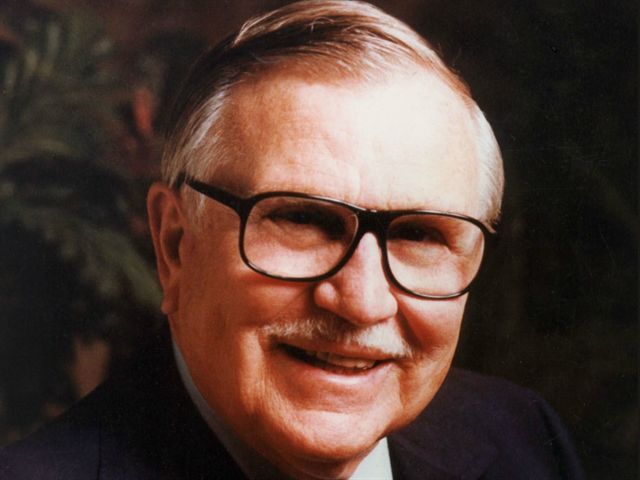
About Dr. J. Vernon McGee
John Vernon McGeewas born in Hillsboro, Texas, in 1904. Dr. McGee remarked, "When I was born and the doctor gave me the customary whack, my mother said that I let out a yell that could be heard on all four borders of Texas!" His Creator well knew that he would need a powerful voice to deliver a powerful message.
After completing his education (including a Th.M. and Th.D. from Dallas Theological Seminary), he and his wife came west, settling in Pasadena, California. Dr. McGee's greatest pastorate was at the historic Church of the Open Door in downtown Los Angeles, where he served from 1949 to 1970.
He began teaching Thru the Bible in 1967. After retiring from the pastorate, he set up radio headquarters in Pasadena, and the radio ministry expanded rapidly. Listeners never seem to tire of Dr. J. Vernon McGee's unique brand of rubber-meets-the-road teaching, or his passion for teaching the whole Word of God.
On the morning of December 1, 1988, Dr. McGee fell asleep in his chair and quietly passed into the presence of his Savior.
Contact Thru the Bible with Dr. J. Vernon McGee
Mailing Address
Thru the Bible, Inc.
P.O. Box 7100
Pasadena, CA 91109
In Canada:
Box 25325,
London, Ontario
N6C 6B1
Phone Number
(626) 795-4145 or
(800) 65-BIBLE (24253)


