Exodus 34, 35
Ministries > Thru the Bible with Dr. J. Vernon McGee
https://www.oneplace.com/ministries/thru-the-bible-with-j-vernon-mcgee/
Facebook Twitter Instagram YouTubeIf God truly loves us perfectly, then He must perfectly hate our sin. In Exodus 34, see Jehovah—“merciful and gracious, longsuffering, and abounding in goodness and truth, keeping mercy for thousands”—make another covenant with His people. God reminds the children of Israel that He did not save them because they were superior, but because He loves and cares for them as a jealous God.
Steve Schwetz: Have you ever wondered what God's really like? Not what people say about him, not what we imagine him to be, but who he reveals himself to be. Welcome to Through the Bible. I'm Steve Schwetz. We're in Exodus 34 and we've come to one of the most important self-descriptions of God in all of scripture. When Moses returns to Mount Sinai, God proclaims his own name and character, merciful and gracious, long-suffering, abundant in goodness and truth, and yet perfectly just. It's a breathtaking portrait of the God that we worship and a reminder that his mercy and holiness always go hand in hand. Before we begin though, let's read a couple of notes from fellow passengers sitting near us on the Bible bus. Gary from the US writes, my cousin told me about your program on our local Christian radio station. Through that recommendation, I found and downloaded your app. I am an old retired man. I listen to your program daily and my wife got on the bus too. I also got a print copy of Briefing the Bible. After listening for almost a year and reading the guide, I realized that although I have read the Bible for years and have been saved for over 40 years, I still gained a new understanding of scripture. Dr. McGee's program has helped me have a closer walk with the Lord. May God continue to bless and grow this ministry. I look forward to the Bible bus on my phone daily. The ability to hear the current lesson at any time of day makes it even more valuable. Praise the Lord for the Bible bus. I share it every chance I get. And Jovan who listens in Serbia writes this, I just wanted to say this has honestly been one of the best Bible teaching programs I've found. I don't always understand everything when I read the Bible on my own, but when I listen to this, it just makes things click in a simple way. It helps me a lot spiritually, especially when I feel a bit lost or distant because it brings me back and reminds me when I'm actually reading and why it matters. And then our last note is from a listener who catches the Bible bus in South Africa, she shares. Thank you for these teachings in Zulu. My family and I are learning a lot from this program and we enjoy listening together. After each session, we discuss the teachings. This is what Christians truly need these days, sound biblical instruction. Isn't that encouraging? No matter where we live, God's gathering his people around his word and speaking to hearts through it every single day. You know, one more thing before we begin, we're near the end of our study of Exodus and then the Bible bus is going to travel forward to the New Testament as we begin our study in the Gospel of Mark. Now if you haven't already downloaded your free copy of the notes and outlines or our Bible companion for Mark, put that on your to-do list for this week. Both are free, both are available from our app or ttb.org or call 1 800 65 Bible. Let's pray. Lord, would you change our hearts and minds as we listen and take your truth to heart? Bless your word to sow good seed in every home, every community, and every country where it's heard. In Jesus' name, amen. Here's our study of Exodus 34 and 35 on Through the Bible with Dr. J. Vernon McGee.
Dr. J. Vernon McGee: Now friends, as we come today to this 34th chapter, you'll notice it and I trust that those of you going through with us will read along as you go. You'll find that it'll make the study more interesting to you, I'm sure. You will wonder how in the world it could ever have any application for us today. And yet, all scripture is profitable and this scripture is also. And I'm reading now at verse one. And the Lord said unto Moses, hew thee two tables of stone like unto the first. And I will write upon these tables the words that were in the first tables which thou breakest. And be ready in the morning and come up in the morning unto Mount Sinai and present thyself there to me in the top of the mount. And no man shall come up with thee, neither let any man be seen throughout all the mount, neither let the flocks nor herds feed before that mount. And he hewed two tables of stone like unto the first. And Moses rose up early in the morning and went up into Mount Sinai as the Lord had commanded him. And he took in his hand the two tables of stone. Now you have here actually the second tables of the law. The first, you'll recall, when Moses went down at the time they made the golden calf and worshipped it. After breaking those, he now comes back to the mountain and he has with him these blank tables now. Verse five, and the Lord descended in the cloud and stood with him there and proclaimed the name of the Lord. And this is very important to see, for this is a tremendous advance for both Moses and the children of Israel. He's proclaiming now his name. A name has a meaning. And I do not mean by that like you find in the Old Testament that so many names have a certain meaning, but that a name always conjures up in the thinking of people certain things. When you hear the name of Caesar, what do you think of? When you hear the name today of Nazi, the Nazis, what do you think of? What do you think of when you hear the name Egypt or the name Israel? Well, God's proclaiming now his name and it comes out of the experience that these people have already had since they left the land of Egypt. Now will you listen to this? This is a glorious revelation of God. And the Lord passed by before him and proclaimed the Lord, that is Jehovah. And now he says, Jehovah God merciful and gracious, long-suffering and abundant in goodness and truth, keeping mercy for thousands, forgiving iniquity and transgression and sin. And that will by no means clear the guilty. Now God does not extend mercy by shutting his eyes to the guilty or by just saying, well, we'll forget it. He doesn't. Sin must be punished. There must be the penalty paid. And he by no means clears the guilty. But what happens? He's keeping mercy and he forgives iniquity. And how does he do it? Well, because a sacrifice has been provided. And every sacrifice they made in that, they didn't take away sin, but it pointed to the one who did when he came 1,900 years ago. So this is still a marvelous revelation of God. And it says, visiting the iniquity of the fathers upon the children and upon the children's children under the third and the fourth generation. And today, you need to remember that you can commit a sin that will affect your children and your grandchildren and your great-grandchildren and your great-great-grandchildren. I was taking abnormal psychology in college and it was actually my second major. And I almost accepted a scholarship to go on to study it. To me, it was quite fascinating. We went over in Tennessee to a place called Bolivar. That's where the mental hospital is. And the man in charge was speaking to our class, showed us the different forms of abnormality. Here were the schizophrenias, here were those suffering from paresis. Here were others that were suffering from some other mental disease. Manic depressive psychoses are some other form. And he showed us one group. And some member of the class asked him, what caused the disease? Well, he said it was either the sin, and that was the doctor's answer, the sin of the fathers are the sin of the grandfathers. And he said it could have been the sin of the great-grandfathers. And a doctor in Nashville took me one time to the hospital one morning as he operated on some children, blind children, but it was to give them partial sight. And I asked him, I said, what made them blind? He said it was the sins of their fathers. Believe me, friends, you don't beat God. You don't get around him. You don't fool him. You don't break his laws with immunity. God always always works the same and he doesn't change. But thank God you can always say in the first revelation here, he keeps mercy for thousands, forgiving iniquity. We only turn to him. Now will you notice he says verse eight, and Moses made haste, bowed his head toward the earth and worshipped. And he did well to this is a marvelous revelation of God. And he said, Moses now speaking, if now I have found grace in thy sight, oh Lord, let my Lord, I pray thee, go among us for it's a stiff-necked people. And here we go again. This is about the fourth time these people have been called a stiff-necked people. And I hope by now you realize God never saved them because they were superior or because they were doing so well, a promise to do so good. They are a stiff-necked people. And pardon our iniquity and our sin and take us for thine inheritance. Wonderful prayer of Moses again, you see. Verse 10 and notice, and he said, Behold, I make a covenant. Now it's God speaking to Moses for the children of Israel. Before all thy people, I will do marvels such as have not been done in all the earth nor in any nation. And all the people among which thou art shall see the work of the Lord, for it is a terrible thing that I will do with thee. Now the terrible thing here isn't quite like it sounds to us. It means to insight terror. And it doesn't mean it's terrible in the way we think of a thing being terrible. Now God says he's to do this why? Well, it was part of the shield that God was putting around these people. They would have been devoured by the enemy had he not done this. Verse 11, Observe thou that which I command thee this day. Behold, I drive out before thee the Amorite, the Canaanite, the Hittite, the Perizzite, the Hivite, the Jebusite, and the Electric light. He's driving them all out and this is about the third time he's mentioned this. Now he says, take heed to thyself, lest thou make a covenant with the inhabitants of the land whither thou goest, lest it be for a snare in the midst of thee. Now God warned them not to make a covenant with the people in that land. Now when the Gibeonites came, you will recall to Joshua after they got in the land, they pretended they had come from afar and they had old stale bread to prove it. At least it proved it to Joshua. Now will you notice verse 13, But ye shall destroy their altars, break their images, and cut down their groves. And the reason they were to do this, God says it'd be dangerous for you to make a covenant with them. Association would bring you back to idolatry. For thou shalt worship no other God, for the Lord whose name is jealous is a jealous God. You'll worship no other God, for the Lord whose name is jealous is a jealous God. And you don't need to apologize for God being jealous. I heard a wife once say, my husband is not jealous of me. And she was boasting of that. Well, I want to say this and I didn't say it, but I wanted to at the time. And I said I think you could also say they didn't love you then. He's not jealous of you. You see, anything or any person you love, you're jealous of them. Not in a wrong way or an evil way, but since you love a person, you have a concern and a care for them. Verse 15, Lest thou make a covenant with the inhabitants of the land and they go a whoring after their gods and do sacrifice unto their gods and one call thee and thou eat of his sacrifice and thou take of their daughters unto thy sons and their daughters go a whoring after their gods and make thy sons go a whoring after their gods. Thou shall not make thee molten gods. Now that land was absolutely just covered with idolatry, just like a dog's covered with fleas. That land was filled with idolatry and with gross immorality. And God is warning them to be separate from those people. Make no covenant with them at all. And they're to be destroyed actually or driven out of the land. And of course the critic down through the years has sure harped on that. Well, why? Well, because he hasn't really understood or apparently investigated just why God did want them put out of the land and want his people not to make a covenant with them. Of course his people did go into idolatry. That was the thing they broke at this particular point and that's the reason they were sent into Babylonian captivity was because of idolatry. They had gone into idolatry. And you find out they did this very thing here. But there's something else. Venerial disease. It was epidemic stage. That's known today that that was in that land. It would have polluted the entire human family and God permitted them to remain in the land, but he didn't. He had to clean them out. And it was a cleanup job that he did. Now we find that he goes on here with these directions that he's giving them. He speaks to them here in verse 18, The feast of unleavened bread shalt thou keep. You see now he's beginning to prepare them to enter the land. And he says in verse 23, Thrice in the year shall all your men children appear before the Lord God, the God of Israel. And then he gives a great many details here concerning different things. For instance, verse 25, Thou shall not offer the blood of my sacrifice with leaven. And he says in verse 26, The first of the first fruits of thy land thou shall bring unto the house of the Lord thy God. They were to put God first. And later on he gives them the feast of first fruits by the way. And these are all their wonderful laws, but I'm not inclined to spend too much time right in this section. And I move on to chapter 35 and again the Lord returns to talk to them about the Sabbath day. This is the third time. And I am reading at verse one of chapter 35 of Exodus. And Moses gathered all the congregation of the children of Israel together and said unto them, These are the words which the Lord hath commanded that ye should do them. Six days shall work be done, but on the seventh day there shall be to you a holy day, a Sabbath of rest to the Lord. Whosoever doeth work therein shall be put to death. Ye shall kindle no fire throughout your habitations upon the Sabbath day. Now you'll find out that as we go along, the Lord insists first of all that the reason for the Sabbath was because it belongs to the first creation. God rested on the Sabbath day. Then he told them that it was a very particular and definite relationship between him and the children of Israel because as mankind left the creative hand of God, he got away from God. And there came a day when he no longer recognized God. He began to worship the creature and he gave up the Sabbath day. Now God said that it was then a peculiar relationship between him and the children of Israel. Then he began to put down these structures that actually apply more to the land than the people than they would to any other place. If anyone did any work on the Sabbath day, they'd be stoned to death. It'd be very hard to carry on our society today without somebody working on the Sabbath day. And that would be Saturday. Of course that's the Sabbath day. And suppose no fire was to be kindled on the Sabbath day. The problem would be great in the frozen north, you see. This was accommodated to that land over there. Now you'll notice verse four and Moses spoke unto all the congregation of the children of Israel saying, This is the thing which the Lord commanded saying, Take ye from among you an offering unto the Lord. Whosoever is of a willing heart, let him bring it an offering of the Lord, gold and silver and brass. Now you'll notice that these gifts for the making of the tabernacle were to be voluntary. The people were not required and no demand put upon them at all. This is not even the tithe here at all. This is to be a voluntary gift. And here are the things that they were to bring, not only the gold and silver and brass, but in verse six, blue, purple, scarlet, fine linen, goat's hair, ram skins dyed red, badger skins, shittim wood, oil for the lights, spices for anointing oil, and for the sweet incense, and onyx stones, and stones to be set for the ephod and for the breastplate. And these were the different things given. You see in that day there was no such thing as a legal tender. That is like our dollar bill and $5 bill or a 50 cent piece. There's nothing like that. And the method of barter was the exchange of goods. And here you have them giving these things to the Lord's work. And I feel very frankly that this is a way today that a great many people can serve the Lord by giving either things that they have. Down in San Diego, I was down there several years ago. A man had two Ampex recorders. They are the very best. He'd bought them thinking they would be very serviceable going around the hospitals and he found out they're big recorder that they took up a great deal of space and were rather awkward to take around. So he had them stored there at his house. And he said to me, I don't need them. If you can use them in your ministry, we'd like for you to have them. And very frankly, these two recorders have become very valuable to us because it means we would have to go out and spend a great deal of money to get them. And they came in at just the right time. It's amazing today. A great many people think that you have to always write out a check. Well, that's needed also when we ask for money on the radio to get one of these machines that duplicates and it's not called a duplicator, it's called something else. But it will take one of my tapes, the one I'm making right now. And it will make I think six at one time. And we keep that machine busy. It's just continually repeating, you see. And that was given to us by Dennis who's very much interested in the program. He bought it for us. So that we found that there are more ways than one to serve the Lord and that's the way these folk have done. And you'll find out and I'm not going to read all of this here, but it's amazing the different things that the people gave. Now of course the question will arise, well, where did they get them? There were slaves in Egypt. Now remember again that they collected back wages. They'd been in slavery a long time and they were paid. The Egyptians were glad to get rid of them and pay them all. And that's what they did. And they left with a great deal of the wealth of the land of Egypt. Now we come to verse 30. Moses said unto the children of Israel, See, the Lord hath called by name Bezaleel, the son of Uri, the son of Hur, of the tribe of Judah. He hath filled him with the spirit of God and wisdom, in understanding and in knowledge and in all manner of workmanship. Now this is the man that we will see. He is the one made these articles of furniture that are so important by the way. And we find here in verse 34 and he hath put in his heart that he may teach both he and Aholiab, the son of Ahisamach, of the tribe of Dan. So you see he was able to pass on this gift that God had given him. And them hath he filled with wisdom of heart to work all manner of work of the engraver, the cunning work. And so this tabernacle was a beautiful thing. It was a jewel in and of itself, not large, not a great big warehouse, but a very small building that was just like a precious jewel. And it's been variously estimated of the amount of money that went into it. And I think it's conservatively estimated that at least $5 million went into the construction of this tabernacle according to the value of the metals in our day. And I expect right now it would go much higher than that. Now that brings us, friends, to the 36th chapter. That's as far as we'll get today, but we're going to pick up there next time. And let me urge you to have your chart of the tabernacle before you next time because we're going to begin now to set up the tabernacle and see just how it functions. May God richly bless each one of you, my beloved.
Steve Schwetz: Well, Dr. McGee's chart of the tabernacle can be found in his notes and outlines for Exodus. And as I mentioned earlier, they're available at ttb.org. Just click on Briefing the Bible. And while you're there, don't miss these other great resources. First, you can sign up for our weekly email this week on the Bible bus. It arrives every Sunday afternoon and gives you a sneak peek of the week ahead including links to listen early if you want. And second, our monthly newsletter, it's really a listener favorite. It includes extra teaching from Dr. McGee, really practical tools for digging deeper into scripture yourself, and inspiring stories of how God is using his word to transform lives around the world. I always look forward to reading it and I know that you will too. And then third, and one of my greatest joys is our world prayer team. Remember the letters that we shared earlier? Well, these stories are just a few examples of what God is doing through his word around the world every weekday. Our world prayer team members receive a short email with specific prayer requests from the front lines of this ministry. So if you've ever wondered how you can help take the whole word to the whole world, this is one of the most powerful ways to do it. Again, get all these resources from our app or at ttb.org. If we can help you, you can always email us, Bible bus at ttb.org. And we always love getting phone calls. 1 800 65 Bible is the number. Now if you'd rather write our address in the US, box 7100 Pasadena, California 91109. In Canada, box 25325 London, Ontario N6C 6B1. I'm Steve Schwetz and I'll meet you back here next time for more great teaching in God's word.
Guest (Male): Today's study is always available, free to stream or download, thanks to the generous and faithful investments from your fellow Bible bus travelers. Just go to ttb.org or download our app to listen again anytime. As always, we'd love to know what's God teaching you.
Related Episodes
Exodus 32:26—33:23
Friday, October 9
Exodus 31:1—32:25
Thursday, October 8
Exodus 30
Wednesday, October 7
About Thru the Bible
Thru the Bible takes the listener through the entire Bible in just five years, threading back and forth between the Old and New Testaments. You can begin the study at any time. When we have concluded Revelation, we will start over again in Genesis, so if you are with us for five years you will not miss any part of the Bible.
Other Thru the Bible Programs:
Thru the Bible - Minute with McGee
Thru the Bible - Questions & Answers
Thru the Bible - Sunday Sermon
About Dr. J. Vernon McGee
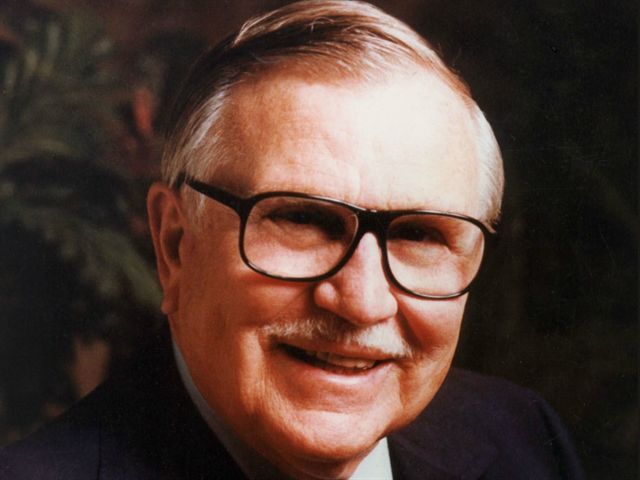
John Vernon McGeewas born in Hillsboro, Texas, in 1904. Dr. McGee remarked, "When I was born and the doctor gave me the customary whack, my mother said that I let out a yell that could be heard on all four borders of Texas!" His Creator well knew that he would need a powerful voice to deliver a powerful message.
After completing his education (including a Th.M. and Th.D. from Dallas Theological Seminary), he and his wife came west, settling in Pasadena, California. Dr. McGee's greatest pastorate was at the historic Church of the Open Door in downtown Los Angeles, where he served from 1949 to 1970.
He began teaching Thru the Bible in 1967. After retiring from the pastorate, he set up radio headquarters in Pasadena, and the radio ministry expanded rapidly. Listeners never seem to tire of Dr. J. Vernon McGee's unique brand of rubber-meets-the-road teaching, or his passion for teaching the whole Word of God.
On the morning of December 1, 1988, Dr. McGee fell asleep in his chair and quietly passed into the presence of his Savior.
Contact Thru the Bible with Dr. J. Vernon McGee
Mailing Address
Thru the Bible, Inc.
P.O. Box 7100
Pasadena, CA 91109
In Canada:
Box 25325,
London, Ontario
N6C 6B1
Phone Number
(626) 795-4145 or
(800) 65-BIBLE (24253)