Mark 12
Ministries > Thru the Bible with Dr. J. Vernon McGee
https://www.oneplace.com/ministries/thru-the-bible-with-j-vernon-mcgee/
Facebook Twitter Instagram YouTubeJesus can read minds and hearts. Mark 12 gives context to many of Jesus’ important parables and teaching. Some of the people questioning Him were sincere; some wanted to trap Him. Jesus read each of their hearts and answered accordingly.
References
Steve Schwartz: After three years of periodic skirmishes between Jesus and the religious leaders, we've arrived at their fiercest encounter yet. Welcome to Through the Bible. I'm Steve Schwartz, and in this study, Dr. J. Vernon McGee tells us that both Jesus and the religious leaders bring their heavy artillery and prepare for the battle of heaven and hell, light and darkness, God and Satan. It sounds like a plot of an epic novel or blockbuster movie, doesn't it? But this is far more important because it's true. So grab your Bible and settle in on the Bible bus. And before we begin, here's a quick but meaningful letter from a fellow passenger named Deborah. I first heard Dr. McGee in 1981 on his Questions and Answers program, and I enjoyed it so much. I was already a believer then and knew he presented the truth. I have just finished my first 5-year trip on the Bible bus. Your enthusiasm for the word of God is contagious. My husband and I support the ministry and pray for your leadership. I'm about to begin my second trip on the bus. My husband was diagnosed with dementia in 2018. He was a Sunday school teacher and deacon for 34 years. I know he has forgotten that he knew the Lord Jesus, but praise God, Jesus has never forgotten him. This program is such a daily blessing to me as I care for my husband. May God bless you dearly, beloved. Well, you know it's true. God never forgets his own. So thank you for that reminder, Deborah. You know, we'd love to hear your story too. So why don't you drop us a note? You can do it in our app. You can do it by email, by simply emailing [email protected], or just call us anytime, leave a voicemail, 1-800-65 Bibles is the number. Let's pray together. Heavenly Father, thank you for Jesus who battled sin and death so that we might have eternal life with you. As we study, Lord, teach us to stand for truth while reflecting his love and grace to those around us. And may many more come to know and believe in him. In Jesus' name we pray. Amen. Fasten your seat belts. We're off to Mark 12 on Through the Bible with Dr. J. Vernon McGee.
Dr. J. Vernon McGee: Now we are ready, friends, for our study today. And I want you to note here in a very particular way that in the 12th chapter, and we'll see in the succeeding chapter, that there are no miracles. And we have stated before that Mark is the gospel of action with the emphasis on miracles. Now according to this premise, it would seem that the action now is slowing down to a standstill. But this is actually the lull before the storm. I'm not sure about what, we've got a lot of action in chapter 12 and 13 that's coming up. And let me give you the outline that we have here. And we have really used some unusual alliteration here. The letter Q is very seldom used, but listen. Jesus quickens the battle with the religious rulers with the parable of the vineyard. And that's the first 12 verses. Verse 13 through 17, Jesus quells the plot of the Pharisees and Herodians about paying taxes to Caesar. And then Jesus quells the skepticism of the Sadducees concerning the resurrection. That's verses 18 through 27. And then Jesus quiets the mind of the scribe about the greatest commandment. And then Jesus questions the Pharisees about the Messiah and quotes Psalm 110. That's verses 35 through 40. And then finally, Jesus qualifies scriptural giving by evaluating the two mites of the widow. And that's verses 41 through 44. Now we are coming, you can see, to a great deal of action that's taking place here. And the Lord Jesus now is the Passover lamb. And he's put up here for close inspection before he's slaughtered. Because you remember that the Passover lamb was put up to be inspected. And all the waves now of man's wrath will roll over his head. And this is not a period of quiet and inaction. We are seeing here the fiercest encounter with these religious rulers. And both sides bring up their heavy artillery, and they make every arrangement in preparation for the battle of heaven and hell, light and darkness and God and Satan. This could hardly be called a period, I think, of inaction or cessation of hostilities. The 3 years of periodic skirmishes of Jesus with the religious rulers breaks out in a bitter verbal encounter. And he takes the initiative. He wins the victory in the verbal area. And they cease to try to trap him here. They had hoped to force him to say something that would turn the people against him. All these questions were loaded. And he precipitated this action by giving the most pointed, plain, and direct parable of his ministry. And that's the one that opens this chapter. The parable of the vineyard and the meaning is obvious. Will you notice this now as we get into it? And I'm beginning reading chapter 12 verse 1. He began to speak under them by parable. And a certain man planted a vineyard and set a hedge about it, digged a place for the wine fat, built a tower, let it out to husbandmen, and went into a far country. This vineyard is that which Isaiah called it, a vineyard he brought out of Egypt, that vine he planted it. That's the nation Israel gave them a God-given religion, the only people that ever had a God-given religion and the visible presence of God. Churches never had that. Now he says, and this is for the religious rulers of his day. Listen to this. And at the season, he sent to the husbandman a servant that he might receive from the husbandman of the fruit of the vineyard. And they caught him and beat him and sent him away empty. And again, he sent under them another servant. And at him they cast stones and wounded him in the head, sent him away shamefully handled. And again he sent another. And him they killed and many others, beating some, killing some, having yet therefore one son, his well-beloved. He sent him also, last under them saying, they will reverence my son. But those husbandmen said among themselves, this is the heir. Come, let us kill him, and the inheritance shall be ours. And they took him and killed him and cast them out of the vineyard. What shall therefore the Lord of the vineyard do? He'll come and destroy the husbandmen and will give the vineyard unto others. And have ye not read the scripture, the stone which the builders rejected is become the head of the corner? This was the Lord's doing. It's marvelous in our eyes. And they sought to lay on him, but feared the people, for they knew that he had spoken this parable against them. And they left him and went their way. Now I think it 's quite obvious what he's talking about in this parable here. The servants that God sent were the prophets. And the certain man that had the vineyard is God the Father. The vineyard is the nation Israel. God chose and protected this nation. The husbandmen were the religious rulers. And therefore he sent his son. That's the Lord Jesus Christ, his well-beloved son. And you remember he answered and said, I'm not sent but unto the lost sheep of the house of Israel. And he came to the world also. Our Lord here is making a deliberate and direct thrust at the religious rulers who stood before him. They had already plotted his death, and he brought their plans out into the light. He knew what was in man. He told the religious rulers what they would do. He prophesied their every step and anticipated their every move. And he charges them with murder before they kill him. I think this is a remarkable incident, friends. He predicts the judgment of the religious rulers. And if you want to see that, move to 78 D when Titus destroyed that city, took them into captivity and looked at the Colosseum in Rome. And it was Jewish slave labor that built that Now will you notice, we have here, this is something quite wonderful. The stone which the builders refused is become the headstone of the corner. That's not another parable. What we have here, this is a two-in-one parable. And Christ was a stumbling stone and a rock of offense to the religious rulers, but many of the people turned to him. And he became the headstone of the corner in the future when he comes again to the earth. And we find that Zechariah spoke of this in Zechariah 4:7. Who art thou, O great mountain? Before Zerubbabel thou shalt become a plain. He shall bring forth the headstone thereof with shoutings, crying, Grace, grace unto it. Now the religious rulers obviously would have taken the Lord Jesus at this time and executed him, but they're afraid of the people, you see. Now this parable of the vineyard set off a verbal war. Notice this. And they send under him. I 'm reading verse 13. Certain of the Pharisees and of the Herodians to catch him in his words. And when they were come, they say unto him, Master, we know that thou art true and carest for no man, for thou regardest not the person of man, but teachest the way of God in truth. Is it lawful to give tribute to Caesar or not? And I think this is a masterpiece. We saw it in Matthew, but look here again. Shall we give or shall we not give? But he, knowing their hypocrisy, Oh me, they were hypocrites. They flattered him. They called him hypocrites. He didn't accept it. He did, by the way, from Nicodemus. But he, knowing their hypocrisy, said under them, Why tempt ye me? Bring me a penny that I may see it. Why'd he ask them for a penny? He's going to use their own coin. That's to be sure, but I don't think he had one himself. Just think of that. The Lord of glory in this world didn't have a dime in his pocket, friends. Can you imagine that, how wonderful he was? He didn't have a coin. He didn't have a lot of credit cards in his pocket like I got here in my pocket, and you've gotten yours today. Can't use them very much, but I got the credit cards. He had nothing like that. He said, Let me have a coin. They gave him a coin, and he asked them the question. You see, if he'd said you'd to pay tribute to Caesar, then that would have meant that he would put Caesar ahead of Moses and of the Messiah. And if he had to said, well, you're not to give tribute, that would be insurrection, would it not in that day? They thought they had him, but they didn't have him. He says, Render to Caesar the things that are Caesar's and to God the things that are God's. Then they marveled at him, and they certainly did. And by the way, that reveals that the child of God has a twofold responsibility. In fact, more than a twofold. Someone said to me sometime ago, my father's in the hospital, my mother is sick, and I have now this money to give to the church. Should I give it to the church or should I help them? And I said, well, if you didn't help them, what would be their situation? Well, they said they'd actually be in dire need. They'd really have to accept charity. Well, I said your responsibility is to them. You see, we can get some very pious ideas today. You and I do have a responsibility to government. Now I think I've got too much responsibility. Frankly, I felt my income tax is this year. They pinched me. They hurt. And I felt that as I saw the way that some of the senators are living today and a big time they can have, and the way that I saw the corruption that's taking place in all areas today of government, I resent very much paying an income tax. I must confess. But I ought to pay some. I recognize I have a responsibility there. I have a responsibility to my loved one. I have a responsibility to my church. I have a responsibility to you today to give the word of God out. I have no business try to promote myself or to promote some organization. I'm to promote the word of God. I think we all have responsibilities. And that's what our Lord is saying. You have a responsibility to Caesar, just charge it. But that doesn't relieve you of responsibility to God. My, this was a marvelous incident that he turned into a parable. Give me a coin. And with that coin, he illustrated, you see a great truth. Now will you notice that he silenced these Herodians who wanted to put the house of Herod into power. Verse 18, then come under him the Sadducees which say there's no resurrection. They were the liberals of the day. They denied the supernatural, and they asked him saying, Master, Moses wrote unto us, if a man's brother die and leave his wife behind him and leave no children, that his brother should take his wife, raise up seed unto his brother. And that by the way is accurate. That was the illustration in the book of Ruth, by the way. That's the law of the kinsman redeemer. They were accurate, you see. They knew what the scripture said. Now there were seven brethren, and the first took a wife and dying left no seed. The second took her and died. Neither left any seed. And the third likewise. The seventh had her and left no seed. Last of all, the woman died also. That's a ridiculous illustration, isn't it? Well, that could be duplicated maybe today in Hollywood or in our contemporary society, but it's ridiculous. Verse 23, their question is in the resurrection. Therefore, when they shall rise, whose wife shall she be of them? For the seventh had her to wife. And Jesus answering said unto them, Do ye not therefore err because ye know not the scriptures nor the power of God? And I would say that that is the difficulty today with those that are so critical of the scriptures. I noticed that right now, these that are promoting a program to cut down the population explosion. And I agree with them though they say that it's contrary to the Bible that God said to Adam, you know, be fruitful and multiply. Well, God said that to Adam, but he didn't say that to the Adams as today. And he's not talking to this present generation. If you were the only man on the earth and you and your wife were the only couple, I imagine that's what he'd say to you because he did repeat it again to Noah when Noah was very much alone. But he didn't repeat that for us today. I can't find that. He's given that to the Christian even. May I say to you how utterly ridiculous. Now it reveals on the part of these folks a woeful ignorance of the Bible. And if they showed that much ignorance in other fields, they would be declared ignorance, so ignorant that they ought not to be heard. And yet today these people spout off about the Bible. Well, of course the crowd that listens to them is a crowd that is as ignorant of the Bible as they are. And our Lord said, there are two things wrong with you Sadducees. You are ignorant of the scripture. You are also ignorant of the power of God. And the answer, of course, to that is just simply this. Well, let's let our Lord answer it. Jesus answering said under them, Do ye not therefore err because ye know not the scriptures, neither the power of God? For when they shall rise from the dead, they neither marry nor given in marriage, but are as the angels which are in heaven. Now that doesn't mean that a man and woman who were to gather down here can't be together in heaven, but they won't be together as man and wife at all. You're not establishing a home up there by any means and raising children. That's the thing that he is saying to them here. And this is a very important thing. Now he says is touching the dead that they rise. Have you not read in the book of Moses how in the bush God spake under him saying, I'm the God of Abraham, the God of Isaac, the God of Jacob. He's not the God of the dead, but the God of the living. Ye therefore do greatly err. They don't know the power of God. Moses is not dead. Abraham's not dead. Isaac is not dead. Their bodies were buried there and he bron, but they are not dead. They've gone to be with him. And that's where the Christians are today that die in the Lord, friends. May I say these devastating in his answer to these religious rulers. Now we have another one that comes at him here. And in verse 28, why he comes and Jesus quiets the mind of the scribe about the greatest commandment. Listen to this. One of the scribes came and having heard them reasoning together and perceiving that he had answered them well, asked him, Which is the first commandment of all? Jesus answered him, The first of all the commandments is, Hear, O Israel, the Lord our God is one Lord. That's I think the greatest doctrinal statement in the Old Testament. Hear, O Israel, Jehovah our Elohim, Jehovah our one God is a Trinity. Elohim, he's one Jehovah, one God. And thou shalt love the Lord thy God with all thy heart, with all thy soul, with all thy mind, with all thy strength. This is the first commandment. By the way, do you keep this commandment, my friend? If there are those listening to me today that say that they don't need Christ as a savior, that they obey God, I'm asking you the question, Do you love God with all your heart, your mind and your soul? Well, if you don't, you're breaking his commandments. You need a savior. And I need a savior. And that's the reason I don't measure up here. I wish I did. I love him though, but not like I should. And the second is like, namely this, Thou shalt love thy neighbor as thyself. How about that one, friend? Do you measure up? There's none other commandment greater than this. And if you can measure up here, maybe you could apply for salvation on your own merit. But until you do, you're going to need a savior. And the scribe said unto him, Well, Master, thou hast said the truth, for there's one God. There's none other but he. But to love him with all the heart, with all the understanding, with all the soul, with all the strength and to love his neighbors himself is more than all whole burnt offerings and sacrifices. It certainly is. And when Jesus saw that he answered discreetly, he said under him, Thou art not far from the kingdom of God. And friends, if you see that you don't measure up and that this is it and that you haven't measured up and you need a savior, may I say to you, then you'll turn to him. We're told that after this, no man after that dares ask him any question. But you know, he's going to ask a few questions. Now he turns to the Pharisees and scribes. And when Jesus answered and said while he talked in the temple, how say the scribes that Christ is the son of David? For David himself said by the Holy Spirit, The Lord said to my Lord, Sit thou on my right hand till I make thine enemies thy footstool. David therefore himself calleth him Lord, and whence is he then his son? The common people heard him gladly. And friends, right there is where he taught his own virgin birth. You see, the son is always inferior to the father, not superior. We're living in a day where evolution says the son is superior to the father. That's not true. It's the other way around. Now if the son is inferior to the father, how could David call his great, great, great, great grandson? How can he call him his Lord? The only way he can is for him to be the Lord, friends. And the only way he can be the Lord is not to be just David's son, but he's going to have to be virgin born. My, this is a great thought that our Lord is giving here. And the common people heard him gladly. That's verse 37. I want to pick up 38. And he said under them in his doctrine, Beware of the scribes which love to go in long clothing. They love salutations in the marketplaces and the chief seats in the synagogues and the uppermost rooms at feasts, which devour widows' houses and for a pretense make long prayers. These shall receive greater damnation. In other words, privilege creates responsibility here. And believe me, he certainly denounced them here. Now here we have the final incident in this chapter. And Jesus qualifies scriptural giving by evaluating the two mites of the widow. This is a marvelous way to end this chapter. And this is right at the conclusion of his ministry. Listen to this. Jesus sat over against the treasury. And behold how the people cast money under the treasury. And many that were rich cast in much. He was there watching them give. Somebody might say, What authority does he have? He has the authority today to stand over when the offerings taken in your church or when you're called to give to some cause for God's cause, his work. He's there to watch you, friends. And he doesn't watch what you give. The principle is, he watches how much you keep for yourself. Now came a certain poor widow, and she threw in two mites which made a farthing. And by the way, she gave two pennies. The important thing to note is, he noted that the rich cast in much. They were big givers. Oh my, how we love the big givers. The rich gave, they gave generously. But you know, he didn't note that. He watched that widow and she gave two mites and compared to the wealth of that temple. Friends, what she gave wasn't worth the snap of your finger. But you know what he did? He took those two mites and he just kissed them into the coin and the gold of heaven. And it made it more valuable than anything that any rich man ever gave. You know why? Because he saw what she kept for herself. She gave all to him. My, I tell you, that's the way measures. We say today, Am I to give a tenth to God, my friend? How much do you keep for yourself? It's not how much you give to him. You're not required to give a tenth. The question is, How much do you really love him? And I think that the day that there are those who ought to give more than a tenth. Precious, I think there's some people today ought to give 50% what they make to the Lord. And by the way, you'd get a better deduction on the income tax if you did give more to the Lord. May I say to you that he is the one that watches how people give. And it's not what they put in. Because that widow didn't give anything, friends. I don't think that anybody else, the treasurer didn't pay much attention to it. Just two pennies. But our Lord kissed it into the gold of heaven. She sure did give a whole lot. We'll have to leave off right there at that particular point. Until next time, may God richly bless each one of you.
Steve Schwartz: Read ahead and meet us next time as our journey through God's entire word continues. And to go deeper yourself, why don't you download our Mark Bible Companion from our app or at ttb.org or call us at 1-800-65 Bible if we can help you find it. I'm Steve Schwartz, grateful to travel with you through the Bible. I'll see you next time.
Guest (Male): Our story on the Bible bus today is just one step in a 5-year journey through the entire word of God. Come along for the ride, and you'll study both the Old Testament and New Testament, discovering God's great redemption story. Is this your story too?
About Thru the Bible
Thru the Bible takes the listener through the entire Bible in just five years, threading back and forth between the Old and New Testaments. You can begin the study at any time. When we have concluded Revelation, we will start over again in Genesis, so if you are with us for five years you will not miss any part of the Bible.
Other Thru the Bible Programs:
Thru the Bible - Minute with McGee
Thru the Bible - Questions & Answers
Thru the Bible - Sunday Sermon
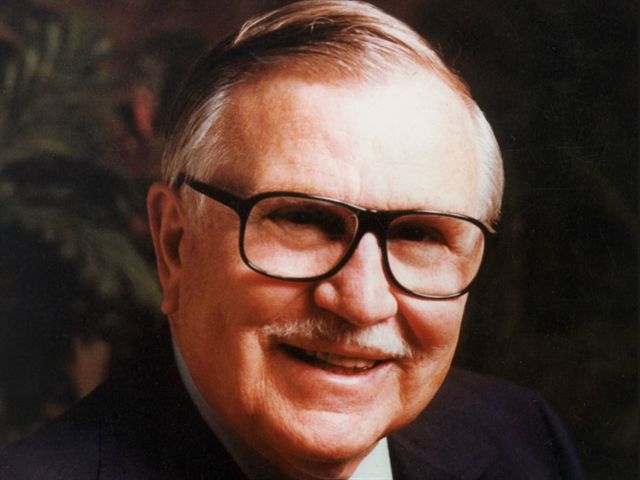
About Dr. J. Vernon McGee
John Vernon McGeewas born in Hillsboro, Texas, in 1904. Dr. McGee remarked, "When I was born and the doctor gave me the customary whack, my mother said that I let out a yell that could be heard on all four borders of Texas!" His Creator well knew that he would need a powerful voice to deliver a powerful message.
After completing his education (including a Th.M. and Th.D. from Dallas Theological Seminary), he and his wife came west, settling in Pasadena, California. Dr. McGee's greatest pastorate was at the historic Church of the Open Door in downtown Los Angeles, where he served from 1949 to 1970.
He began teaching Thru the Bible in 1967. After retiring from the pastorate, he set up radio headquarters in Pasadena, and the radio ministry expanded rapidly. Listeners never seem to tire of Dr. J. Vernon McGee's unique brand of rubber-meets-the-road teaching, or his passion for teaching the whole Word of God.
On the morning of December 1, 1988, Dr. McGee fell asleep in his chair and quietly passed into the presence of his Savior.
Contact Thru the Bible with Dr. J. Vernon McGee
Mailing Address
Thru the Bible, Inc.
P.O. Box 7100
Pasadena, CA 91109
In Canada:
Box 25325,
London, Ontario
N6C 6B1
Phone Number
(626) 795-4145 or
(800) 65-BIBLE (24253)


